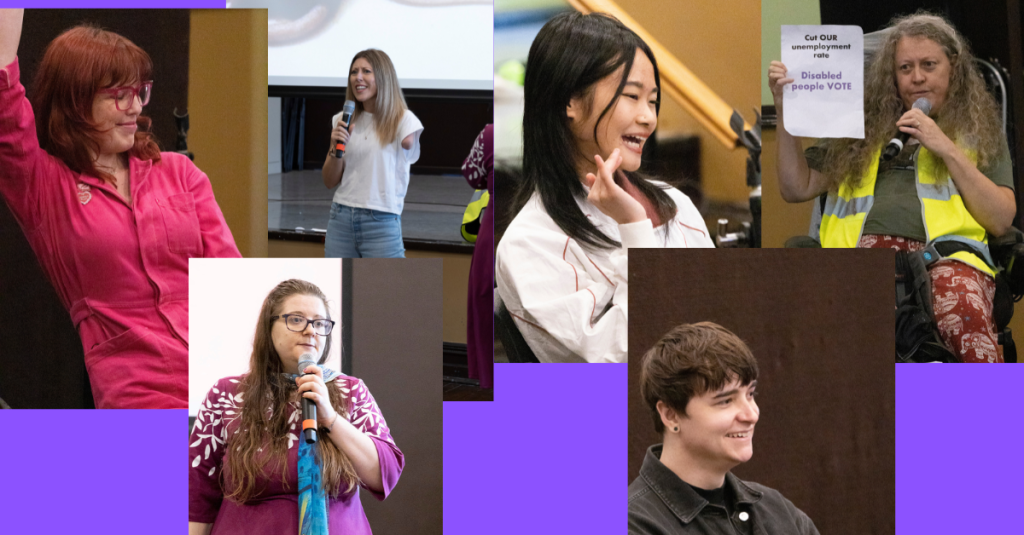
On Saturday April 9th, I attended my first ever Disability Pride Fest, in Newtown NSW.
Wow! It was huge. It’s taken me a while to process my thoughts about it. As Disability Pride month closes, it seems like a good time to pull some thoughts together from the Pride Fest and from Disability Pride Month, celebrated throughout July.
The value and achievements of disabled people were front and centre at the Disability Pride Festival. Non-disabled people were present, but on this day, they were the ones on the sidelines.
This was a day about people with disability /disabled people. A huge variety of us came together to make ourselves visible and claim our space.
I’ve been disabled all my life. I’ve always had some connection with other disabled people but I’ve never before been in a situation where we hold the spotlight – not because we’re super-crip medal winning celebrities or because we are the disadvantaged people who need help but because we are people of strength and vulnerability who understand each other’s struggles and victories in a way that other people simply can’t.
It felt fabulous to trade places for a day and move in from the margins.
There was a lot of energy from a room full of people, pushed down by things beyond our control, coming together to affirm and encourage one another. Five common threads stood out.
We are a community worth celebrating
The Disability Pride Fest demonstrated the diversity of our community. We heard from Deb Roach, a champion pole dancer with one arm, Simon Darcy, an academic who uses a wheelchair, Monica Tran, a Tik-Tok star with Tourette’s, Olivia Evans – a high school teacher with Obsessive Compulsive Personality Disorder, Hannah Solomons a lawyer currently doing a PhD in disability rights, Amy Claire Mills, a neurodivergent artist with cystic fibrosis and diabetes, Bronek Lemow a Deaf activist and writer who uses Auslan, Lara Nakhle who shared her beautiful singing voice and is blind. We are people whose achievements are worth noting, not just people with difficulties.
We are not a problem to be solved
… although several people spoke of being treated that way. Living with disability means that we face different challenges to people who aren’t disabled. We experience life differently and we often do things differently. We have to think creatively to work around living in a world that is not made to cater for us.
Disability Pride calls on the wider community to also think creatively and considerately to make the effort to include us.
Several people shared their experience of being offered, “cures” by strangers – everything from insistent suggestions that “you should try yoga” or “you just need to meditate” to people stopping us in the street wanting to pray for our healing.
Most people with disability don’t want the suggestions or prayers of strangers in the street. We’re quite capable of seeking out appropriate medical attention for ourselves where it might help but we’re not as obsessed with “being cured” as most able bodied people seem to be on our behalf.
The consensus on the day was that when you see us in the street, what we’d really appreciate Is to be treated just like anyone else. We’re not looking for medical or lifestyle advice from random strangers on how to be cured. We don’t see ourselves as a problem to be solved.
Amy Claire Mills put it plainly. “I don’t have grief about my life. My life is my life. It has struggles. I was born with disability. I will die with disability. I have struggles but it doesn’t mean that I’m sad because of it and I really hate when society constantly tells us that It’s negative to be disabled. While we all accept it is extremely difficult to live in an ableist society, we aren’t the problem. We’re not the problem”.
Unfortunately, many people still see us as a problem. On an episode of the ABC’s Q&A, that went to air during Disability Pride Month, a disability activist asked a question about how Australia could do better to support disabled people who are subject to domestic violence.
Only one panellist was invited to respond and her response was telling. The panellist spoke not to the question but instead about domestic violence as a cause of disability. The undercurrent of what she said was, “if we stop domestic violence, we will address the problem of disability”. She was totally focussed on “fixing the problem of disability”. She completely failed to address how to support people who concurrently experience disability and domestic violence – as if such people don’t even exist. Unfortunately, they not only exist but experience violence at higher rates than non-disabled people, making it even more significant and distressing that the question was used aa stepping stone to a different concern rather than being directly addressed .
We are part of normal human diversity
Disability has always been a normal (if less common) part of human experience. Medical advancements change what we’re dealing with and how we deal with it but there will always be variety, misadventure and old age that results in disability. Some of my disabled peers narrowly escaped being hidden away in institutions because only about 50 years ago, when we were born, society didn’t even want to deal with the existence of disabled people. Parents were sometimes still being encouraged by doctors to institutionalise disabled children, forget them, and “have another family”. At the Disability Pride Fest, we weren’t hidden or forgotten. We were on the stage. We were seen and heard on our own terms.
The stories we told were often not stories of acceptance. Hannah shared how she been made to feel “unfeminine” at school because she is Autistic. I talked about my struggle to find work – despite the fact that there are plenty of things I can do, because so many workplaces have a step or two that prevents me from getting in or because a lot of employers assume that I’m capable of much less than I am. Deb spoke of feeling unwelcome at school simply because she only had one arm. One of the people who came along drew attention to the fact that the Australian government refuses people permission to migrate to Australia if they are disabled.
We told our stories because that’s how you challenge a culture of hiding and dismissing. You challenge it by being loud and proud about who you are. You challenge it by speaking up.
I’ve spent Disability Pride Month posting on social media every day to share the stories of disabled people who have participated in their communities, sometimes built careers and defied the exceptionally low expectations that society has of disabled people. I’m hoping that will help people realise that we are and deserve to be part of the community and that they should expect to discover us amongst their circle someday if they haven’t already.
We share solidarity
Disability comes in a lot of different packages. I was reminded, at the Disability Pride Fest, that there are a lot of disability experiences that I don’t share and I need to work hard to understand them. Living with Autism or Tourettes, for instance is really different to living with Cerebral Palsy. Even people who have the same label for their disability that I do, can experience it in a very different way. The variety of people and disabilities that were represented at the Disability Pride Fest was huge but at the same time there was a strong sense of common experience and solidarity. It wasn’t just that we all shared the experience of having been pushed aside or ignored by society but we also shared the desire and commitment to see that change and the conviction that it should.
We are working for change
No one who spoke at the Disability Pride Fest wanted a “business as usual” approach to disability. We were there to amplify our voices as people who don’t often get heard – like Amy who is immunocompromised and felt completely disregarded by the government response to COVID and Bronek who, as a Deaf person, feels most natural speaking Auslan but was pushed to use speech as a child for the convenience of hearing people.
Immunocompromised people are members of our community, not people we can be less concerned about losing because they have “underlying health conditions” (as do a sizeable percentage of the population).
During COVID, we have seen some progress on the inclusion of Auslan speakers. Let’s hope it continues. Change only happens as we speak up.
As Disability Pride Month draws to a close and I look back on the success of the Disability Pride Fest despite COVID and pouring rain, I hope we’ve made some progress towards a truly inclusive world;
- A world where every person is valued for what they can do rather than disregarded for what they can’t
- A world where disability is accepted as an ordinary part of human experience
- A world where everyone (not just disabled people) takes responsibility to think creatively and maximise inclusion
If you appreciate this article and want to support Rolling Through, please, give it a Like, make a comment and share it on social media. You can also visit my Home page to subscribe to email updates and donate to keep me rolling!


 Rolling Through
Leave a comment