
Dylan Alcott is Australian of the year for 2022. Dylan is a gold medalist in wheelchair tennis and wheelchair basketball. He just won a Golden Slam in tennis (all four tennis majors and a gold medal in the same year). He’s a television personality. He’s also a disability advocate.
It’s hard to know what the balance was in the minds of the people who chose Dylan Alcott as the Australian of the year. All of his achievements are part of the picture and they are impressive. He’s certainly not the first male sports star to receive the award. He is the first recipient with a visible disability, though not the first disabled recipient. (Last year’s recipient, Grace Tame, has autism.)
Whatever the priorities of the selectors, Dylan is definitely there to advocate for and represent disabled people.
“My purpose is changing perceptions so people with disability can live the lives they want to live,” he said .
How much will the visibility and respect accorded to Australia’s disabled community progress in 2022 during Dylan Alcott’s time as Australian of the year? It could be THE year for Disability Pride.
What’s Disability Pride?
It means not being ashamed of being disabled.
Disability Pride means recognising that disability is an ordinary, though not so common, part of human experience, like other types of disadvantage, and calling on the community to recognise that.
Disability Pride means people with disabilities refusing to settle for being cast aside as broken and useless. It means we look for and expect opportunities to live a good life, according to our capabilities – just like people who aren’t disabled. It means that when we don’t find those opportunities, we protest and work for change.
Disability Pride is a phrase I baulked at when I first heard it. As a Sydney resident, images of LGBTIQA+ pride, particularly associated with the Mardi Gras, are familiar – images of gender diverse people celebrating their diversity with masses of colour and glamour. Did Disability Pride ask me to celebrate my disability?
Then there’s the Black Pride movement, strongly associated with the USA but shared by the First Nations peoples of Australia where “black is beautiful”. Was I being asked to say “disability is beautiful”?
That felt a bit weird. Everyone’s experience of disability is different. Dylan Alcott said in his acceptance speech that he loves his disability. Like Dr George Taleporos, I can’t echo that. I can’t love the extra time it takes me to do physical tasks, or the pain I occasionally experience doing something ordinairy. I don’t love the limits on my body that aren’t ones most people share.
On the other hand, I am proud of who I am. My disability has shaped me. It’s probably key to my commitment to justice and inclusion for anyone who is pushed aside – on whatever basis – because I know what it feels like. I want to fight back. So, it doesn’t make sense to me to be proud of my disability but I’m proud of the disabled person that I am.
I think there’s a subtle difference between Disability Pride and other kinds of Pride. Disability includes impairment. Being LGBTIQA+ or black, in itself, doesn’t, (although there are plenty of people who are disabled and LGBTIQA+, disabled and black or all three.) By definition, being disabled means there are ordinary human things I can’t do.
I have cerebral palsy. Nothing changes the fact that the part of my brain that controls motor function doesn’t send clear and strong messages to my muscles. There’s some static in the messages and there always will be. That imposes limitations.
Like many other humans dealing with a disadvantage, I accept the hand I’m dealt and do the best I can with it. I look for ways to make progress and feel good when it happens. Like anyone, I celebrate landing a job and feel bad when I lose one. Unlike most people, I feel good when I get my shoes on without a huge struggle – because that small task often takes a big effort. Disability Pride means accepting the ways my life is different to most people’s without feeling embarrassed or less valuable as a result.
Disability has it’s down side but that doesn’t make disabled people any less human or worthy.
Disability Pride makes that point – loud and clear.
Disability Pride means fighting back when other people exclude me, ignore me, patronise me or treat me like I’m worth less than others because I have an impairment and need to use a wheelchair. It’s about speaking up when shops have a ramp at the entrance but cram the aisles with stock so I can’t move around. It’s about reminding friends and colleagues to find accessible venues and helping them understand that that’s only the first step in inclusion.
Disability Pride means lobbying government; making it clear to MPs that it is not acceptable to increase the number of disabled people forced to look for work, without working with employers to make sure there are jobs we can secure. Disability Pride means calling for action based on respect.
As Dylan Alcott pointed out in his Australian of the year acceptance speech, the disability employment rate is about 10%. It’s more than twice that of the general population and it’s hardly moved in the last 30 years. Plenty of disabled people are able to work, and we welcome the opportunity.
In my experience, most employers put us straight in the “too hard” basket. I can see why. Their priority is to maximise their profits. They don’t often have visions of raking in the cash when they look at disabled job seekers.
I found out this week that the Reserve Bank is a bit behind on the realities of disability and work. Here is their ableist and very misleading graphic about who is and isn’t part of the labour force in Australia. (I added the arrow.)
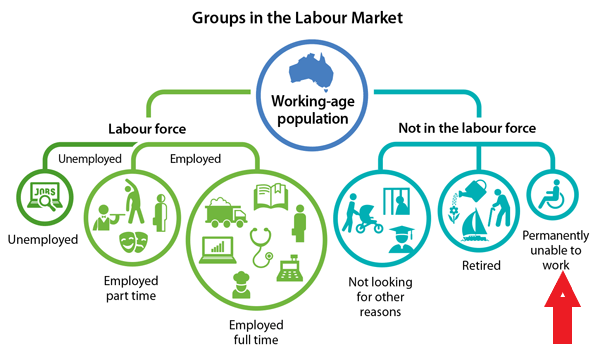
I’ve emailed the Reserve Bank about this and await their response. (Edit: They’ve now changed it to a crossed out briefcase, after I wrote to them.) I was staggered to realise that while governments of both persuasions in Australia have been forcing disabled people to look for work for years, the Reserve Bank was still pushing the stereotype that disabled people can’t work at all.
Fortunately for Dylan Alcott, that message doesn’t seem to have got through to him. He has an impressive resume in business, well beyond sport and television appearances. You can genuinely call him “special”, in the “he’s making an impressive contribution to the world” kind of way, not the “he’s disabled and deficient. We pity him and feel really awkward, so let’s call him ‘special’ because that’ll make us feel better” kind of way that disabled people are often on the receiving end of.
As a disabled person, I sometimes have particular needs that others don’t but that doesn’t make me feel special. Inconvenienced? Yes. Disadvantaged? Yes. Special? No.
The thing that I hope will come to the fore during Dylan Alcott’s time as Australian of the year is the experience he has working with employers to create real work opportunities for disabled people. That’s what I’m excited about.
People who win gold medals and appear on television will always be considered remarkable. Disabled employees often are too but we shouldn’t be. Disabled employees should be ordinary.
I’m hoping that in 2022, with Dylan Alcott as Australian of the year, we will normalise disabled people being employed, going to the pub, traveling, performing, being seen – being included.
But I’m nervous. Like all sports stars and tv personalities, Dylan Alcott is privileged. He’s welcome where others aren’t. Dylan faces a huge challenge to help people see past the glitz and glamour.
Dylan’s profile will open doors.
Once he’s in, how much connection will other people make between him and the disabled people who feel trapped in their homes because they have a high risk of death if they catch COVID?
How much connection will people make between Dylan Alcott, successful entrepreneur, and the job seeker who’s been on the dole for years because they’ve had doors close on them, rather than open?
I get the impression that Dylan will be working hard to represent people who’ve found life tough as a result of their disabilities, but I wonder how much of it will get through to the people he meets.
So far he has raised the question of “equal work for equal pay” – although he was referring to professional tennis players!
Pay equity is good, but seeing everyone have a decent income is more important to me than making sure a few more people get a lot.
Dylan Alcott’s year has only just started. Hopefully, “justice for the many” will be a more prominent part of the conversation soon.
There are a lot of disabled people in Australia working for a more disability inclusive society. I hope Dylan’s spotlight will spill out to the rest of us enough to make the work we all do more effective. I hope it will make us all more visible to the Australian community than we were before he wheeled up that ramp to accept the award.
I hope 2022 sees an unstoppable flood of Disability Pride and inclusion to all parts of the Australian community.
I hope Dylan Alcott has a lot to smile about when he passes the baton to the 2023 Australian of the year!
You can take action to express or support Disability Pride.
On April 9, 2022, the second Inner West Disability Pride Fest will be happening in Newtown, NSW. It’s going to be a huge celebration and recognition of the fact that while disability isn’t always fun or beautiful, disabled people deserve our place in society. It will also be livestreamed. It’ll be awesome!
How do you think disability inclusion will change in 2022? What do you hope for? Let me know in the comments below.
If you appreciate this article and want to support Rolling Through, please, give it a Like, make a comment and share it on social media. You can also visit my Home page to subscribe for email updates and donate to keep me rolling!


 Rolling Through
Leave a reply to Jasper Hoogendam Cancel reply