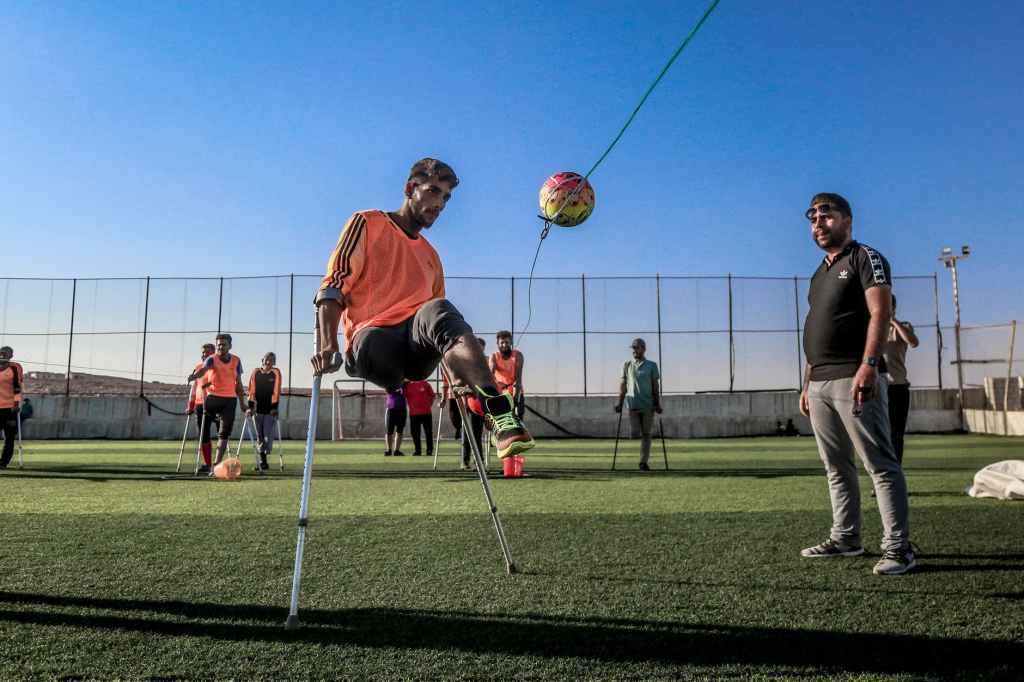
What did you dream of becoming when you were a child?
A teacher? A fireman? An astronaut?
Reaching goals isn’t always easy. As we get older, we learn that not many people have what it takes to be an astronaut. Sometimes we have to adjust our dreams to be a bit more realistic.
I was born with cerebral palsy. My disability has always had an impact on how I participate in the community. Everyone’s dreams have to fit with what their body can do. When you have a disability, that can be quite significant.
The basic pathway to independence – get a job, pay your own bills make your own choices and fulfil your dreams can be filled with barriers for disabled people, and yet it’s the only pathway to independence that our society offers (unless a rich relative dies and leaves you all their wealth). As a result, people with disability are often excluded, not just as workers but as participants in society.
How can we do better? A Guaranteed Income sufficient to live on – with additional funds to cover the extra costs of living with a disability – could give disabled people, a pathway to independence. A Guaranteed Liveable Income would free disabled people to make the most of the opportunities we have in life and participate in our community.
What if working or not was a choice?
Being disabled means you don’t have all the same options that non-disabled people do – including employment options. A guaranteed liveable income would mean you wouldn’t be penalised for that. You wouldn’t have to convince someone else that you deserved support, either.
Under a welfare system, you have to satisfy a government official that you are poor enough, disabled enough, sick enough or disadvantaged enough to receive money to live on.
With a guaranteed liveable income if you get sick, experience a crisis or just need time out, you have money to live on. You don’t have to apply for it. It’s there. Everyone is given the freedom to make our own decisions about what expectations are reasonable to put on ourselves. For disabled people, a guaranteed liveable income offers greater freedom to make our own choices about whether work is a realistic option we want to pursue. Those who do work will be able to take time out when they choose to or need to.
What if poverty wasn’t a threat?
For years, Australia’s government has denied more and more disabled people the Disability Support Pension (DSP). They’ve kept both the DSP and the job seeker payment low, leaving many people in poverty. They argue that providing job seekers with a liveable income removes the incentive to work.
Does it?
Surely there are other reasons why people work. What about developing skills, working to achieve something, and the things you learn from interacting with people you wouldn’t otherwise meet? Some people work because it gives them purpose – a reason to get out of bed every morning.
It’s possible to fulfil all of those human needs through hobbies or sport but for a lot of people, many of them are fulfilled through work. They’re among the reasons a lot of disabled people are interested in working. We don’t need to manufacture poverty to produce a workforce!
What if money spouted up from the bottom, rather than trickling down?
On a Guaranteed Liveable Income, disabled people with low employment income will no longer be living in poverty. We won’t be punished for being unable to work or unable to secure work. This will have a huge positive impact on the physical and mental health of disabled people and our family and friends. We will have the funds to eat well, socialise with friends in cafes and bars, attend the theatre, go to community meetings, pursue hobbies, be included. The money we spend is likely to be spent locally and contribute to the local economy, so regardless of whether we work, we will create the option for others to do so.
What if more visibility created more acceptance?
If disabled people can afford to show up as customers, businesses and community groups will start to expect us to do so. They will have a profit motive to provide disability access and support. Disability inclusion will be transformed from a charity response to a profit-making imperative. Change will happen.
Better social inclusion will improve our chances of employment.
If people meet us as part of their community, they are more likely to imagine us being employed by or beside them and expecting it to happen.
People in the community can talk to us. They can learn what we are actually capable of instead of making assumptions about us. We can share our dreams and find common ground.
When poverty keeps us at home, none of that happens. Employers and workers continue to hold the unchallenged assumption that we have nothing to offer – that we are unemployable. After a while, that becomes a self-fulfilling prophecy. Poverty keeps disabled people out of sight, out of mind and out of employment.
What if humans were innately valued?
A guaranteed liveable income means the value of a human being is no longer determined by our value as a unit of production. This makes disabled people members of the community on a more equal footing with our non-disabled peers. We are no longer forced to compete for employment at a constant disadvantage.
A Guaranteed Liveable Income makes it easier for human beings to be valued for the things we can’t always put a dollar figure on like the emotional support we provide for each other and the satisfaction we find in developing skills and creativity.
A Guaranteed Liveable Income means that if you enjoy creating art and you want to spend your time doing that, you can. You can enjoy it and share it with the people around you. You are not required to perform to a standard where your art is commercially viable to justify the time you spend on it. The emotional and social value it has is sufficient. For disabled people, it means doing what we can do is enough. We won’t be constantly judged to have failed as human beings if we can’t earn enough to live on.
Given the opportunity to explore and develop their talents, some disabled people may move from creating for fun to developing a creative business. How many new businesses never start because people don’t have the freedom to try? A Guaranteed Liveable Income offers that freedom.
A Guaranteed Liveable Income also provides the freedom to fail. If you have money to live on, you can afford to experiment. Disabled people often need to use different strategies to achieve the same goals as other people – and we don’t always know whether something will work until we try. A Guaranteed Liveable Income means we can try, fail and try again.
What if government didn’t set disabled people up for failure?
Before COVID, about 40% of Australians on unemployment payments had disabilities. Successive governments have required more disabled people to look for work but we haven’t seen increased success in finding it. The disability unemployment rate in Australia hasn’t changed in 30 years. We are twice as likely as others to be out of work and our employment rates haven’t changed in 30 years. Like many in the Australian community, employers tend to have low expectations when it comes to the contribution disabled people can make. Few are keen or confident to take on disabled workers.
Disabled people are required to look for work with little chance of success. It actively reduces our ability to contribute to our community. It damages us.
At one stage, I sat in a doctor’s office considering whether I needed support for depression. The rejection I was continually subject to in my unsuccessful job search was taking its toll. I knew that the problem was a direct result of unrealistic expectations imposed by government policy, rather than a failure within me, but I was running out of options. Soon after leaving the doctor’s office I joined a progressive political party. The support I found there meant I avoided the need for medication. That doesn’t work for everyone. A Guaranteed Liveable Income would remove the pressure to find employment.
What if government set disabled people up to succeed?
A Guaranteed Liveable Income removes compulsion from the employment support system. Employment consultants will no longer be paid to be compliance police. They will be people who focus on helping disabled job seekers identify and develop our employability skills as well as identifying and addressing any barriers to employment that we face. Disability employment support will be about considering the opportunities that we have and working with us to determine what kind of support could help us reach our employment goals. Disabled people who see employment as a realistic goal will be able to pursue it strategically, without being required to beat their head against a brick wall when the way is blocked.
What if disabled people had a pathway to develop skills?
Our lower employment rates mean disabled people have fewer opportunities to develop employability skills and yet, every advertised job requires “demonstrated skills” in something.
As a wheelchair user, even a lot of the entry level jobs like sales assistant, waitress, or barista are not practical for me. For others, those jobs help people prove that they are employable. Those jobs can pay the bills on the way to something better and sometimes provide the chance to learn new skills. When disabled people are unable to get those jobs, we also miss out on the better opportunities they prepare you for. A Guaranteed Liveable Income could allow disabled people to volunteer or complete a traineeship as an alternative pathway to develop employability skills. It could improve our chances of securing employment or simply provide a place to contribute and be included.
What if disabled people could enjoy a love life?
Everyone wants to love and be loved. Being on welfare can make it really tough to have that kind of relationship. It’s costly to be the partner of someone on the Disability Support Pension. Australia’s welfare system pays less depending on a partner’s income as well as giving the welfare recipient a below poverty payment. It robs people on welfare of financial independence.
Some of us can’t afford the financial penalties of living with the one we love. Disabled people often face many more barriers to finding a partner and maintaining an intimate relationship than non-disabled people – and miss out on the joy and support that a good relationship brings. Removing this financial barrier gives us more freedom to enjoy relationships, when we find them.
A Guaranteed Liveable Income offers some insurance in case the dream relationship becomes a nightmare. The rates of physical and sexual violence are much higher for disabled people than others. Leaving can be harder. It’s crucial that disabled people are not trapped in abusive situations by lack of funds.
A Guaranteed Liveable Income for disabled people stops disadvantage from becoming punishment. It offers disabled people support, choice, freedom and participation. It would fundamentally change the experience of being disabled in Australia. It would lay the foundations for Australian society to think realistically and creatively about where disabled people fit. It would enable us to maximise the possible. A Guaranteed Liveable Income for disabled people is a goal that’s worth striving for.
What do you think of the idea of a Guaranteed Liveable Income as a means of supporting disabled people. Give me your thoughts in the comments.
If you appreciate this article and want to support Rolling Through, please, give it a Like, and share it on social media. Visit my Home page to check out more articles and subscribe for email updates. You can also donate to keep me rolling!

 Rolling Through
Leave a reply to Erica Black Cancel reply